Ambulance Lights
Recreate the alternating red and blue flashes of an ambulance light bar with two LEDs, a Raspberry Pi and Pi4J.
Ambulance Lights
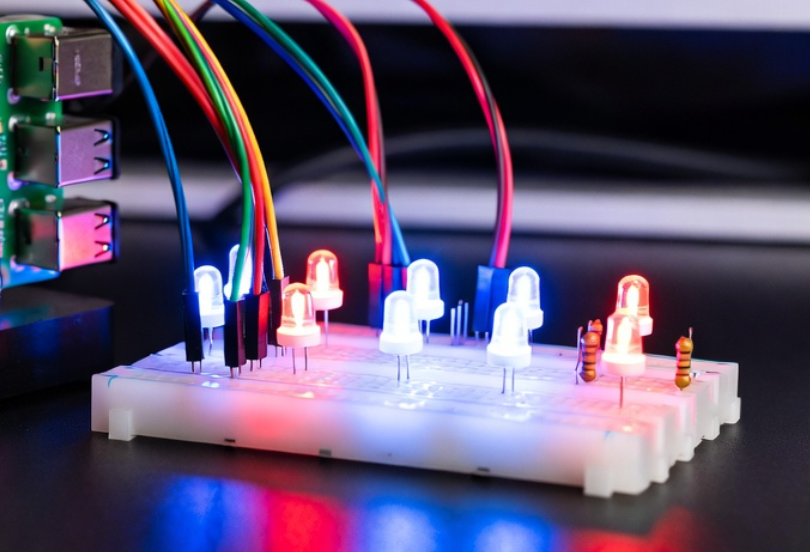
Emergency vehicles have a very distinctive visual signature — a rapid, alternating flash of red and blue lights that instantly grabs attention. With just two LEDs, a Raspberry Pi and Pi4J we can recreate that effect on a breadboard.
This project builds directly on the Blink LED example. Instead of a single LED going on and off, we alternate two LEDs so that when one is on, the other is off.
Source code: projects/ambulance/Ambulance.java
What You Will Learn
- How to control multiple GPIO pins from Java with Pi4J
- How to alternate outputs to create a "flashing" effect
- How timing changes the perceived intensity of the flash
- How to organize a small Pi4J program with more than one LED
Components
- Raspberry Pi
- 1 red LED
- 1 blue LED
- 2 × 220Ω resistors
- Breadboard
- Jumper wires
Wiring
- Connect the anode (longer leg) of the red LED to a GPIO pin through a 220Ω resistor.
- Connect the anode of the blue LED to another GPIO pin through a 220Ω resistor.
- Connect both cathodes (shorter legs) to any GND pin on the Pi.
- Double-check the polarity before powering the Pi.
How It Works
The program configures two GPIO pins as digital outputs, one for each LED. Inside a loop it turns the red LED on and the blue LED off, waits a short delay, then flips them. Repeating this cycle produces the alternating flash you see on real ambulances.
Shorter delays give a nervous, urgent flash. Longer delays feel calmer and closer to a warning beacon. Play with the timing until it feels right.
Possible Enhancements
- Add a small buzzer for a siren sound
- Add a physical button to start and stop the flashing
- Use PWM to fade between the two lights instead of a hard switch
- Add extra LEDs on each side to build a full light bar
Why It Matters
This is a tiny project, but it is the first step toward more expressive lighting patterns: police cars, tow trucks, fire engines, disco lights. Any effect that alternates between two states is essentially this program with different colors and timings.