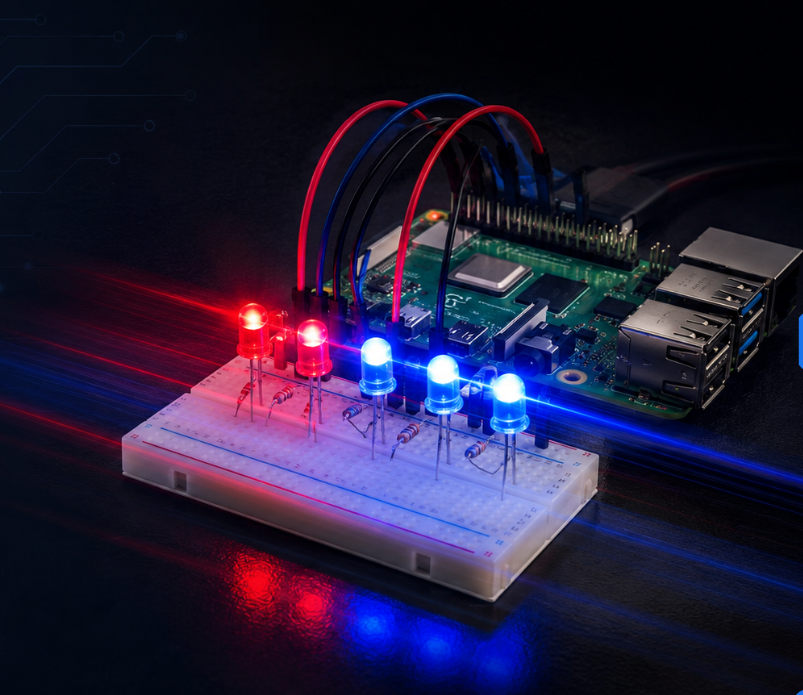
Police Lights
Simulate the fast double-flash red and blue strobe of a police car using two LEDs, a Raspberry Pi and Pi4J.
Police Lights
Police cars use a much more aggressive light pattern than a simple back-and-forth. Each side of the light bar usually fires two or three quick strobes before the other side takes over. That double-flash rhythm is instantly recognizable.
In this project we simulate that effect using two LEDs — one red and one blue — controlled from a Raspberry Pi with Pi4J. It is a natural next step after the Ambulance Lights project.
Source code: projects/police/Police.java
What You Will Learn
- How to build more complex blinking patterns with nested loops
- How to control two LEDs with independent timings
- How rhythm and grouping change the visual "personality" of a light
- How to keep GPIO code readable when patterns become more elaborate
Components
- Raspberry Pi
- 1 red LED
- 1 blue LED
- 2 × 220Ω resistors
- Breadboard
- Jumper wires
Wiring
- Connect the anode of the red LED to a GPIO pin through a 220Ω resistor.
- Connect the anode of the blue LED to another GPIO pin through a 220Ω resistor.
- Connect both cathodes to any GND pin on the Pi.
How It Works
The program configures two GPIO pins as digital outputs. Instead of a simple alternating flash, each side fires three quick strobes before handing over to the other side. A short delay between the two bursts sells the "police strobe" feel.
The pattern is essentially:
- Red strobes three times, very fast.
- Short pause.
- Blue strobes three times, very fast.
- Short pause.
- Repeat.
Tweaking the number of strobes and the on/off durations gives you a whole family of related effects.
Possible Enhancements
- Add a siren tone with a piezo buzzer
- Add more LEDs on each side for a fuller light bar
- Randomize the number of strobes per burst for a more chaotic effect
- Trigger the pattern with a button press
Why It Matters
Once you can time nested patterns like this, you can drive almost any real-world signal light: fire trucks, tow trucks, road hazard beacons, and construction lights. It is a great exercise in structuring blinking code that goes beyond a single loop.